The Science of the Heart
“For centuries we have asked whether to trust the heart or the head. Now the better question is why we ever separated them in the first place.” New Scientist.
According to the New Scientist a closer connection between our hearts and minds, helps us to become happier, healthier and more skillful at coping with life’s challenges. Research by the HeartMath Institute demonstrates that by practicing heart coherence and self-compassion, we are able to reduce the impact of anxiety and stress while boosting our confidence, creativity and resilience. New Scientist also explores interoception — our body's "sixth sense" for internal signals like heartbeat, breath, and hunger — and the growing evidence that it plays a central role in anxiety, depression, and other mental health conditions.
In the early 1990’s, Dr. J. Andrew Armour discovered the heart contains a complex, independent network of around 40,000 neurons similar to those found in the brain. This enables the heart to sense, feel, process, remember and send information independently, not just respond to the brain. In fact, it sends around 80% more signals to the brain than vice versa.
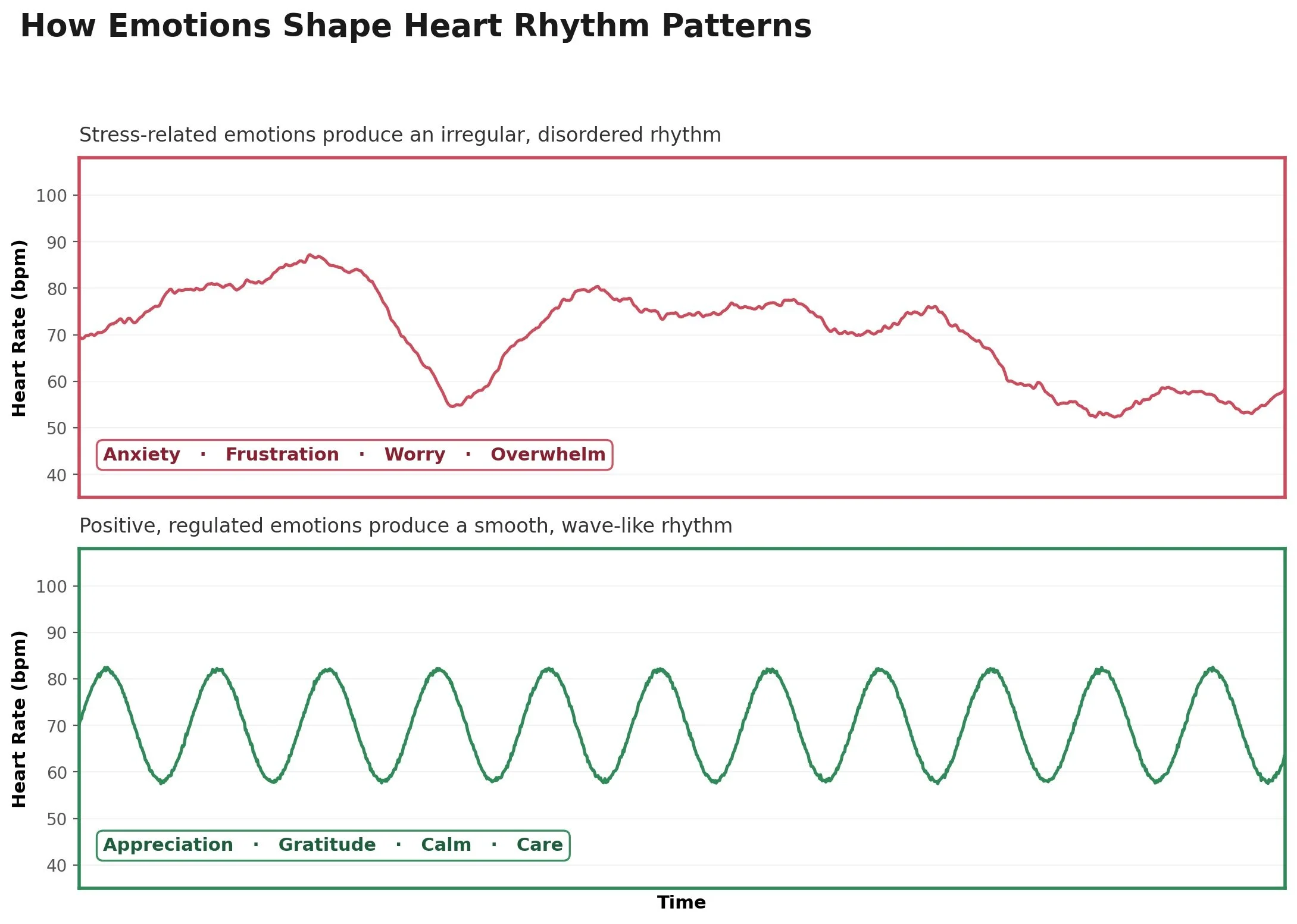
Research shows that when we are in a state of heart coherence — where our heart rhythms, breathing, brain and nervous system are working together in harmony (like an orchestra playing in sync) — we can think more clearly, make better decisions and perform better. Heart coherence also helps us to regulate our emotions and view life’s challenges from a wider perspective, enabling us to think more flexibly and find more creative solutions to challenges. It can also help us to access more positive mindsets, greater empathy and intuition, all of which can improve our relationships with ourselves and others.
The ability to sense what’s happening in our bodies (otherwise known as ‘interoception’) is integral to our awareness of our hearts. When we are constantly in our heads, in ‘thinking’ mode, it’s hard to sense what’s going on in our bodies, but when we drop down into ‘feeling’ mode, we can access a wider field of intelligence.
Neuroscientist Dr Sarah Garfinkel explains the concept of interoception in this TED talk
To bring us into a state of heart-brain coherence, we need to be in our parasympathetic system, (rest, relax and digest mode) as opposed to our sympathetic system (fight, flight or freeze).
There are several ways to achieve this, which we set out in the Practices section of this website.